
What Should I Do if the Insurance Company Contacts Me?
When you’ve been injured after a car accident,slip and fall,animal attack or other incident, the person who is responsible probably expects theirinsurance company to handle the situation. That makes sense since we buy insurance to protect us from losses.
For their part, however, insurance companies don’t quite see things the same way. They might handle the claim, but their method of handling it might involve doing whatever they can to avoid paying the claim. After all, insurance companies are in business to make a profit, and they make more money when they pay out as little as possible.
So the bottom line is that insurance adjusters and investigators will be looking for ways to deny a claim or reduce the value of the claim. They have even been known to delay claims for so long that the statute of limitations passes and the victim loses their right to seek compensation.
You do not want to give the insurance company any ammunition they can use against you to undervalue or deny your claim for damages. That means you must be extremely careful about what you say and do in the days following an injury. Insurance company representatives may try to pressure you into making a statement or answering questions, but you are not legally required to talk to them, and you do not need to follow their agenda. Here’s what to do instead.
Tell Them to Talk to Your Lawyer
The safest—and easiest–thing to do when the insurance company contacts you about a claim is to refer them to your attorney. Allow your legal professional to advocate on your behalf. Attorneys are trained to spot the tricks insurance companies use to devalue claims, and they are not likely to be caught off guard. They know that certain statements can be used against you, even if taken out of context.
Your lawyer can supply the information needed by the insurance company while refraining from sharing information that could be used to deny or reduce the value of your claim. Relying on your legal advisor to communicate on your behalf is one of the best ways to protect your claim.
Personal injury attorneys work on a contingent fee basis, so you pay them based on results rather than the time they spend assisting you. By hiring an attorney early on and taking advantage of all the assistance your attorney can provide, you are getting the best value for your money because you’ll get more service for the same legal fees.
Get Information from Them
If you want to be polite, or you aren’t ready to hire an attorney, you can take advantage of the opportunity to collect information for yourself before you provide any information to them. You can ask for the full name of the insurance company and the name of the representative, as well as their title and contact information. You should write down the information, taking the time to get the spelling right so there can be no misunderstandings later when you share this information with your attorney.
When you’ve finished asking your questions, and they start asking theirs, try to give them as little information as possible. You can furnish your name, phone number, and address—which they already have anyway. You can give them the date and time of the incident, but you don’t need to volunteer any other information, including the name of your insurance company or details about the accident or your injuries. Write down notes about anything you talk about so you can inform your attorney later. Consistency is very important, so if you tell them a collision occurred at 111 Main Street, and your attorney later lists the address of the accident as 113 Main Street, they may insist that you are unreliable.
At the end of the conversation, inform the insurance company that they should not call you again, but you can say that you will contact them.
You Are Under No Obligation to Speak to the Other Person’s Insurance Company
Remember that no matter how friendly and helpful an insurance representative seems to be, they are not your friend and they are not going to be helpful. They will be working to collect information to be used against you and you do not have to give them that information. In fact, you are not legally obliged to say anything to them at all. They know that, but they may pressure you to talk anyway.
If you were in a motor vehicle accident, you can be certain that there will be communication between your insurance company and the other party’s insurance company. When you work with an experienced personal injury lawyer, your attorney will understand when to contact the insurance company and what to say.
In situations where your injuries stem from a collision involving your vehicle, you will need to report the accident to your own insurance company. You can provide a little more information to your company, but you want to carefully avoid saying anything that could be speculation rather than fact. You don’t know for certain what caused the accident at this point, and you don’t know the full extent of anyone’s injuries, including your own. If your insurance company asks what happened, tell them you will provide a written statement. Then your lawyer can work with you to write up a statement that avoids potentially problematic issues.
Insurance Companies May Be Recording Your Calls
Dealing with an insurance company after a personal injury can be a challenging and sometimes frustrating process. While they may seem helpful and concerned about your well-being, it’s essential to remember that insurance companies are primarily focused on minimizing their own financial liabilities. One tactic they may employ is recording your phone calls in an attempt to catch you saying something that could hurt your personal injury case.
Insurance companies have sophisticated tactics to protect their bottom line, and one of them involves recording phone conversations with claimants. They may use these recordings as a way to gather evidence that can be used against you in your personal injury case.
Why Do They Record Calls?
- Misleading Questions: Insurance adjusters are trained to ask questions that may lead you to make statements that could be detrimental to your case. They are looking for inconsistencies or admissions of fault, even if you didn’t actually do anything wrong.
- Selective Editing: In some cases, insurance companies might use selective editing or out-of-context statements to misrepresent what you said during the conversation, making it sound like you’re accepting blame or downplaying your injuries.
- Pressure Tactics: Some insurance adjusters may use the threat of recorded statements to pressure you into settling for less than your case is worth. They hope to catch you off guard and obtain statements that weaken your position.
Protecting Yourself
To safeguard your personal injury case and ensure that you don’t inadvertently provide information that could harm your claim, consider the following precautions when communicating with insurance companies:
- Consult with an Attorney: Before speaking with any insurance company, it’s advisable to consult with a personal injury attorney. They can provide guidance on what to say, what not to say, and whether you should allow recorded statements at all.
- Limit Communication: Keep communication with insurance companies to a minimum. Direct all inquiries, requests, and discussions to go through your attorney. This can help filter out potentially harmful statements.
- Be Cautious: If you do decide to speak with an insurance adjuster, be cautious about the information you provide. Stick to the facts and avoid speculating or making assumptions. Do not admit fault, even if you think it may have been partly your fault.
- Record Your Own Notes: After each interaction with an insurance company, make your own detailed notes about the conversation. Include the date, time, the name of the representative you spoke with, and a summary of what was discussed. This can serve as a useful reference in case there are disputes later.
- Understand Your Rights: Familiarize yourself with your legal rights as an accident victim. You have the right to legal representation, and you don’t have to agree to recorded statements if you don’t feel comfortable with them.
Insurance companies may use various tactics to protect their interests, including recording your phone calls to gather evidence against you. To protect your personal injury case and your rights, it’s crucial to be cautious when communicating with insurance companies and consider seeking legal advice from an experienced personal injury attorney. Your attorney can help you navigate these tricky waters and ensure that you don’t inadvertently jeopardize your claim by saying something that insurance companies could use against you.
Let your attorney talk for you:
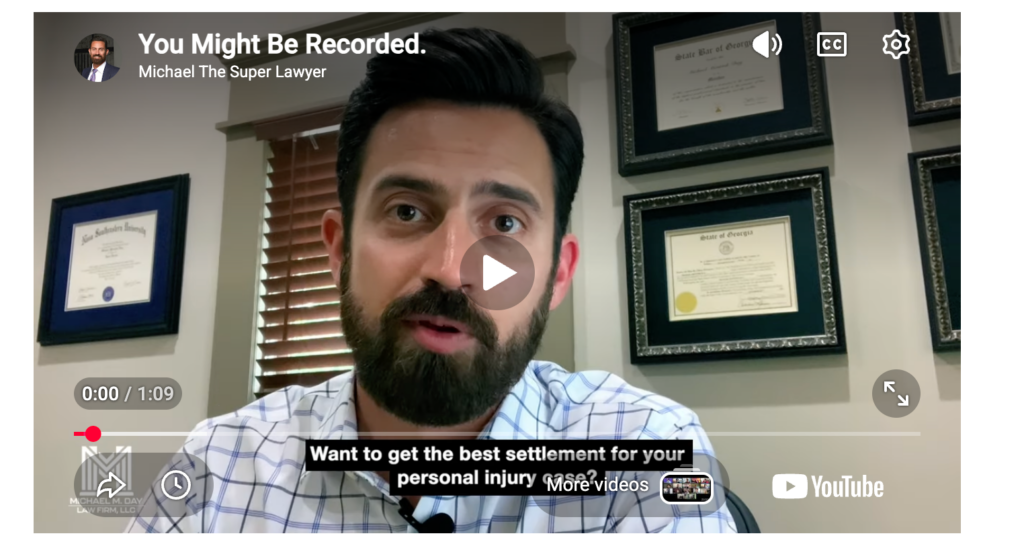
“They (insurance companies) want you to say something that they can later use against you, to lower the value of your case.”
You May Be Recorded, Michael M. Day
What to Avoid at All Costs
If the charm of an insurance representative keeps you on the phone, here are some steps to avoid at all costs:
- Do not allow anyone to record you.
- Do not say, “I’m fine,” even if you just mean it as a polite conversation. The insurance company can argue that your statement means you are not hurt.
- Do not say you’re sorry even if you feel bad for someone. The insurance company can take this as an admission of guilt.
- Do not engage in friendly conversation.
Remember, the insurance company is trying to trick you into saying the wrong thing. Don’t give them the opportunity.
The Insurance Company Will Try to Argue That Your Injuries Were Caused by Something Else
If you’ve been hurt because of someone else’s negligence, it only seems fair that the responsible person should do something to make up for the harm you’ve experienced. Ideally, that person would undo all the damage, give you back the time you’ve lost from your life, and erase the suffering you’ve endured.
But obviously, that can’t happen. Most of the time, all the person responsible can do is pay compensation to cover your expenses and provide a small amount of justice for your anguish. And realistically, it is almost never the person who hurt you who ends up paying compensation after a car accident, slip and fall, dog bite, or other incident. Instead, it is that person’s insurance company.
The insurance companies are the archenemies of experienced personal injury lawyers like us. We know their weaknesses. But we also know that if they catch us (or our clients) off guard, they can be very dangerous.
They like to win almost as much as we do, and, like us, they spend all of their time trying to do just that. So, regardless of which injury law firm you’re working with—and particularly if you don’t have an attorney yet—we want you to be aware that the insurance company will try every tactic known in the legal world to try to avoid paying you fair compensation for your injuries.
One tactic that often takes victims by surprise is the lengths insurance companies will go to prove that your injuries were due to something besides the accident. If you’re not prepared, this argument can prevent you from recovering the full amount you should receive, and it could block your recovery completely.
Your Attorney Needs to Prove Every Element of Negligence, No Matter How Badly You are Hurt
To understand why this tactic by insurance companies unfortunately succeeds so often, you need to realize that in every accident case, even the ones that settle out of court, the legal team of the accident victim needs to be prepared to prove all four elements of a negligence claim. In general terms, you need evidence to prove:
- Number One: That the person you’re seeking compensation from had a duty to do something to protect the victim from harm. For instance, trucking companies have an obligation to ensure that the equipment they put on the roads is safe and operated by drivers with appropriate training. That duty is owed to everyone on the road, including drivers of other vehicles and pedestrians.
- Number Two: That the person you’re seeking compensation from didn’t fulfill that duty. In the example of the truck accident, the victim would need evidence that showed how the company didn’t meet reasonable standards for safe operation. The attorneys might uncover records that show that the trucking company skipped scheduled maintenance or sent out a driver with absolutely no experience or instruction.
- Number Three: That the failure to fulfill the duty is what actually caused the injuries. This involves two steps. You need to prove that the irresponsible action caused the accident, and that the accident was the reason the victim is suffering from injuries.
- Number Four: That the victim suffered the harm you’ve claimed in the case. This is usually proven with medical records and expert testimony about the long-term effects of injuries.
While any one of these four elements can be challenging to prove, the third element is often the most difficult. In our truck accident example, if the driver of the truck had lost control and hit a passenger vehicle, we might show that if the vehicle had been maintained properly and the driver had known how to handle it, then the accident would not have occurred. Then we would also need to show that if the accident had not occurred, the victim would not be suffering the injuries that they are now. Many people assume that would be obvious, but that is a risky assumption.
It is Essential to Get a Complete Medical Exam and Follow the Doctor’s Instructions
If you or a loved one suffered harm, such as traumatic brain injuries, in an accident, you need to prove that the injuries were caused by the accident before you can recover compensation. One of the most important ways you can gain evidence to support that assertion is to go to the doctor and get a thorough exam right after the accident. If you are not taken to the hospital in an ambulance, go on your own and tell the staff you’ve been in an accident.
Some symptoms of head injuries and damage to internal organs don’t start to show up until later, as fluid builds up in the brain or other parts of the body. So if you start to notice new symptoms or your symptoms get worse, go back to the doctor. Each visit gives you more medical records that connect your injuries to the accident.
The longer you wait, and the more time that passes from the accident until your medical exam, the more chances you give the insurance company to argue that something you did after the accident is the true cause of your injuries.
It is also important to follow the instructions from your doctors. If they tell you to come back in three days, then do it. If they tell you to stay in bed, do it. Otherwise, the insurance company will insist that it was your actions that made your injuries so bad.
Let Michael M. Day Talk to the Insurance Company Instead
At Michael M. Day Law Firm, LLC, we understand how to communicate effectively with insurance companies and all the best steps to take to protect your rights and obtain the compensation you deserve after an accident. We fight relentlessly to secure the right damage award to compensate you for the suffering, pain, and costs as well as funds to provide for your future needs. For a free case evaluation and consultation, call 404-480-4284 or contact us online today.