
Uber and Lyft Accidents: Does it Matter Whether Georgia Law Considers Them “Motor Carriers” or “Transportation Network Companies?”
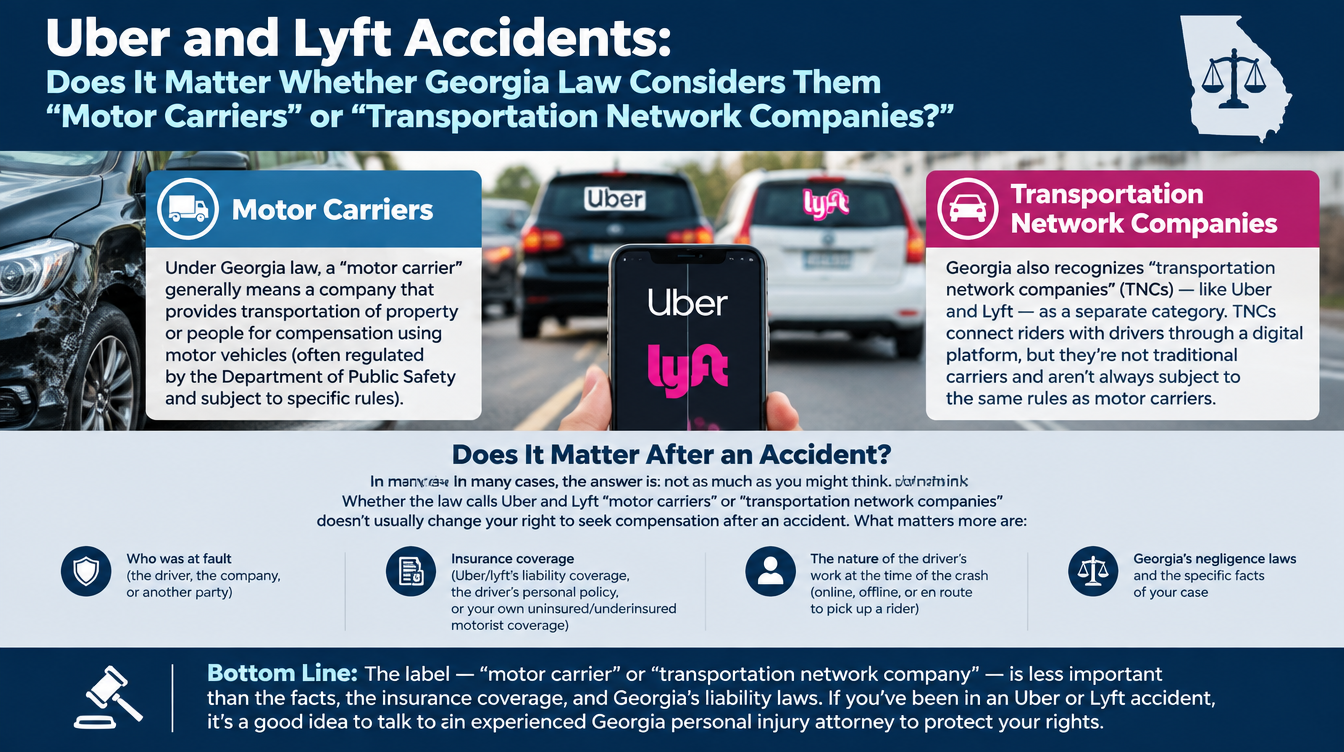
Rideshare companies like Uber and Lyft have dramatically changed the transportation scene in the Atlanta area. Lawmakers have not been quite sure how to classify these companies. Should they be considered “motor carriers” like taxis and bus companies? Or are they “transportation network companies” as Uber and Lyft claim to be?
The classification affects the rules these companies must follow. But does the classification matter if you’ve been in a car accident involving an Uber or Lyft driver? If you contact a personal injury lawyer to discuss the circumstances of your accident, you can get an answer that applies to your specific situation. Here are some general factors that affect Uber and Lyft accidents.
Defining the Terms
The Georgia Code defines a motor carrier as anyone who owns a motor vehicle used in the business of transporting people or property on public roads. There are some exceptions. Taxis are not treated as motor carriers if their operation is governed by a local municipality. Ambulances are not considered motor carriers, even though they transport people for a fee. Limousines, like taxis, are sometimes exempted from motor carrier status.
Transportation network companies are defined in a section of the Georgia Code on insurance requirements. The definition specifies that these companies are entities that use digital networks to connect customers to network drivers who provide transportation for payment. A similar definition is provided in the transportation code for the term “ride share network service.” This definition seems geared specifically to Uber and Lyft. It defines this type of service as an entity that uses a network to connect passengers with ride-share drivers for prearranged transportation for hire.
Rideshare companies describe themselves as transportation network companies and insist that they are not motor carriers. These companies try to insulate themselves from legal liability for what happens during transportation.
Georgia Court of Appeals Determines that Rideshare Companies are Motor Carriers
In 2024, the Court of Appeals of Georgia ruled that the rideshare company Lyft was a motor carrier as defined by the Georgia Motor Carrier Act. At the same time, the Court recognized that the company was also a “ride share network service” as defined in the transportation statutes. In other words, Lyft and Uber can be considered both.
The court noted that although the Motor Carrier Act exempted certain taxi and limousine services from classification as motor carriers, it contained no exemption for rideshare companies. They concluded that rideshare companies were “clearly engaged” in the business of transporting people for hire on public roads and that, therefore, these companies should be considered motor carriers as well as ride share network services.
This case involved a rideshare accident where the victim had been injured by a driver operating for Lyft. In this case, the reason that classification as a motor carrier was so important is that it gave the accident victim the ability to file a lawsuit directly against the rideshare company’s insurance provider of the rideshare company.
However, the law has been amended to allow such direct lawsuits only in very specific circumstances. Under Section 40-2-140 of the Georgia Code, an accident victim can sue the insurance carrier directly only if the motor carrier at fault in the case is out of business or if the legal team has been unable to serve a lawsuit on the motor carrier or driver.
It is Important to Be Aware of All Applicable Requirements and Think One Step Ahead
Legal rules governing which parties may be added to lawsuits at different stages of the proceedings can be quite complex. This is one reason it is important to work with a personal injury attorney who has extensive experience litigating claims in court. Even if most cases settle before the actual trial date, the insurance company is much more likely to offer a full damage award if they can tell that an accident victim’s legal team is prepared to win in a trial. If the legal team enters the process expecting to settle rather than litigate, they might not care whether they have taken certain steps to add parties to the case or to advance arguments to hold parties accountable. If the insurance company knows that the victim is less likely to succeed in court, they may offer a much lower settlement.
Requirements for Rideshare Network Services
As rideshare network services in Georgia, Uber and Lyft are subject to certain legal requirements set forth in Section 40-1-193 of the Code. These include:
- Ensuring that drivers maintain their driver’s licenses in good standing
- Performing background checks on drivers, even if they are independent contractors
- Establishing a zero-tolerance policy for drug and alcohol use while drivers are on duty
- Ensuring that drivers have appropriate Insurance coverage for bodily injury and property damage
If they fail to comply with any of these requirements, that can be used as evidence to help establish liability for an accident involving one of their drivers.
Michael M. Day Law Firm Understands How to Recover Full Compensation for Rideshare Accidents
Accidents involving drivers who work for Uber and Lyft tend to be much more complicated than other car accident claims. One reason is the involvement of the rideshare companies, of course. But the different regulations that apply to cars used in rideshare operations also complicate these cases.
To receive full compensation for injuries, including damages for pain and suffering, an accident victim needs to understand how to avoid potential missteps that could prevent recovery. That can be very difficult without guidance and representation by the right personal injury attorney. At Michael M. Day Law Firm, we know how to work effectively to secure recovery in rideshare accident cases. To discuss your case and the compensation that may be available, schedule a free case evaluation with our team by calling 404-480-4284 or contacting us online today.